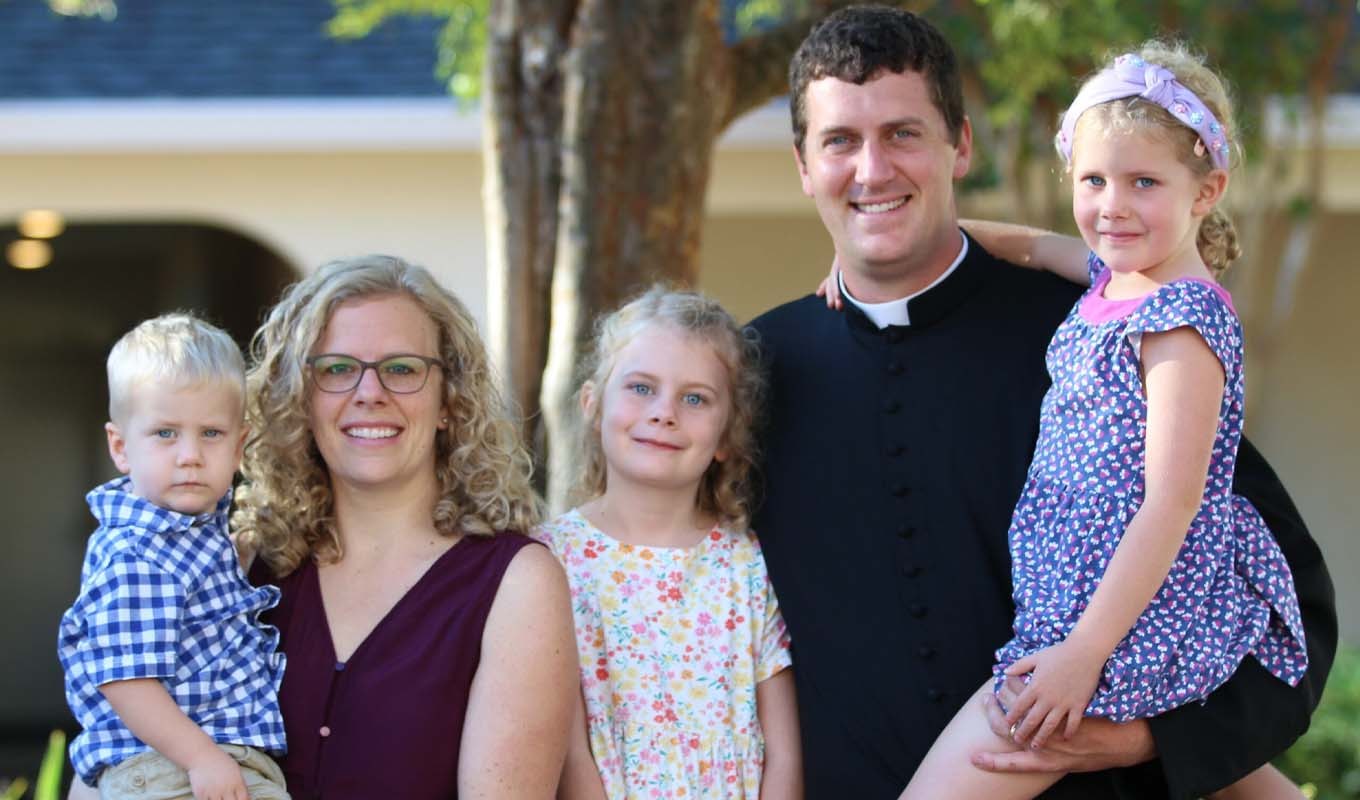
Mark and Andrea Perkins with their three children are Samaritan Ministries members who live in Virginia.
New school hopes to form young men through faith, work and community
By Michael Miller · May 26, 2026
Father Mark Perkins felt he had a calling to teach, to be a minister, and to live in a natural setting with his young family in Michigan.
The Samaritan Ministries member had the right calling but the wrong place.
Mark, an Anglican priest, is now chaplain and assistant headmaster at St. Dunstan’s Academy near Waynesboro, Virginia, an all-boys Anglican boarding school on a 180-acre farm in the Blue Ridge Mountains.
St. Dunstan’s is being built from the ground up. Right now, the only students there are high school graduates in the school’s Joshua Program who are helping to build a dormitory, an all-purpose building, and offices. In the process, they are learning more about carpentry. And their faith.
“This program is helping young men live their vocation of service to Christ, to their communities, and to their families,” Mark said.
Classical model of education will be used
St. Dunstan Academy’s tentative plan is to start ninth-, 10th-, and possibly 11th-grade classes in fall 2027, limiting grade levels to 12 students each. The curriculum will be built on the classical model with help from a Hillsdale College curriculum.
“Our curriculum will be full of poetry and Scripture and history and philosophy,” said Thomas Fickley, headmaster and founder of St. Dunstan’s.
He said the trivium (grammar, logic, and rhetoric) will teach students how to use language, and the quadrivium (arithmetic, astronomy, geometry, and music) will teach numbers as they are applied throughout the world.
But the boys also will grow their own food on the school’s land and be able to enjoy and learn more about nature and practical skills than they would in a typical school setting. In fact, the school is named for a 10th-century archbishop of Canterbury who was also known for teaching, music, and manual crafts like bell-making.
“As much as possible, we want to integrate their math curriculum with the building arts so they encounter trigonometry not as an abstraction but as the answer to a timber-framing problem,” Mark said.
The setting will also be instructive.
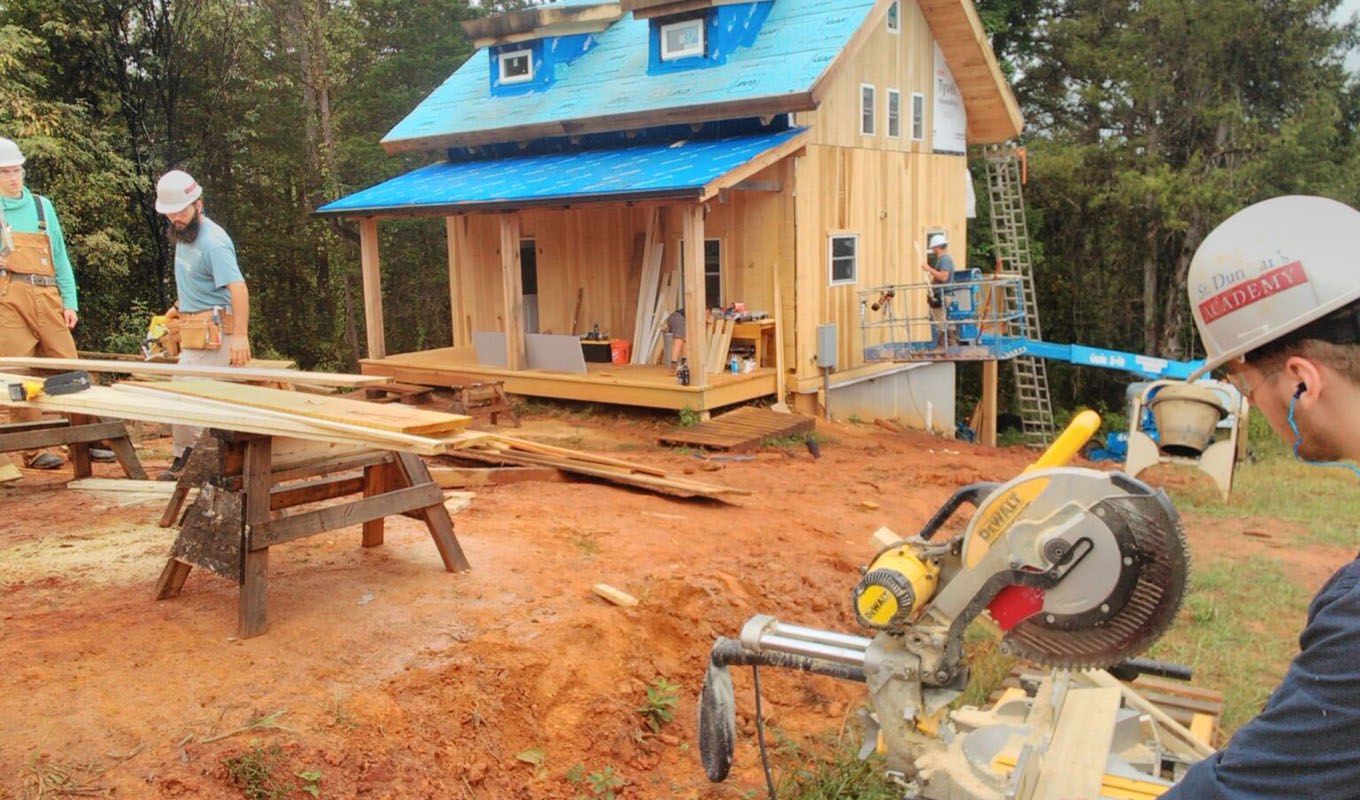
A crew of young men work a new building at St. Dunstan's Academy, an Anglican boarding school in Virginia.
“A number of church fathers say God has two books: the Holy Scriptures and the created order,” Mark said. “Most teenagers are cut off from both of those in our culture, so we want them rooted and saturated in Scripture, and we want them rooted and saturated with the natural world and natural beauty. So we’ll teach outside as much as we can as well.”
Vision for community
That desire to be close to the earth has long been a goal for Mark and his wife, Andrea. They even worked for a few months in Germany on a small organic farm.
And while the practical agricultural lessons there were helpful, the setting was also a blessing.
“You could hear the church bells from almost every field, and you could see the spires sticking up above the trees in most of the fields,” Mark said. “So that vision for a kind of humane scale of community oriented around the church really captured my imagination.”
At one time, Mark and Andrea had considered moving to Michigan’s Upper Peninsula to start a congregation, farm, and teach. Instead, the Lord led them south, where Mark served as curate at St. Alban’s Anglican Cathedral in Oviedo, Florida. That campus also houses The Ecclesial School at Saint Alban’s, led by Samaritan member Kevin Clark.
‘Sending out godly, Christian young men’
St. Dunstan’s is private and independent but is affiliated with the Anglican Province of America. However, the school’s advisory council includes people from the breadth of Christian denominations.
“Our vision is raising up and sending out godly, Christian young men,” Mark said.
One way that is done is by restricting enrollment and staff to males, he said.
“For one thing, the kinds of rites of passage by which boys become men—and in a different sense girls become women—have always and everywhere been single sex. While we learn an enormous amount about life, faith, maturity, et cetera, from adult mentors in general—both men and women—it is the case, everywhere and at all times, that men teach boys how to be men.
“And then there are also sorts of classroom- and school culture-related benefits as well. I joke, sort of, that my Spanish class grade was much worse than it would have been otherwise because I was distracted by flirting with my future wife ... and hers was probably slightly lower because this obnoxious boy kept distracting her.”
Plus, Mark said, "If your best and worst students are all male, you cannot end up assuming that academic achievement is for girls and failure is for boys. So, ironically perhaps, single-sex spaces are effective in avoiding false or unhelpful gender stereotyping."
Digital poverty
Students at the school also take a vow of digital poverty.
“There are no screens, no phones, no digital music players—it’s all analog,” Mark said. “The goal is that they become productive and dependable members of their community rather than dependent consumers.
“Our goal isn’t to pull young men out of culture, but to pull them out of mainstream culture. We turn the volume down on mainstream culture.”
Samaritan memberships provided to staff
St. Dunstan’s has been able to help staff leave mainstream culture behind as well by providing them with Samaritan Ministries memberships.
“Our faculty was already using health care sharing, and they were all pleased with their experience,” headmaster Thomas Fickley said. “They settled on it as what seems like the most logical option for Christians who are trying to take care of each other and have help with their medical needs.”
Three staff members are on the group membership right now. As the faculty expands to its goal of 12, new staffers will also have the option to become members.
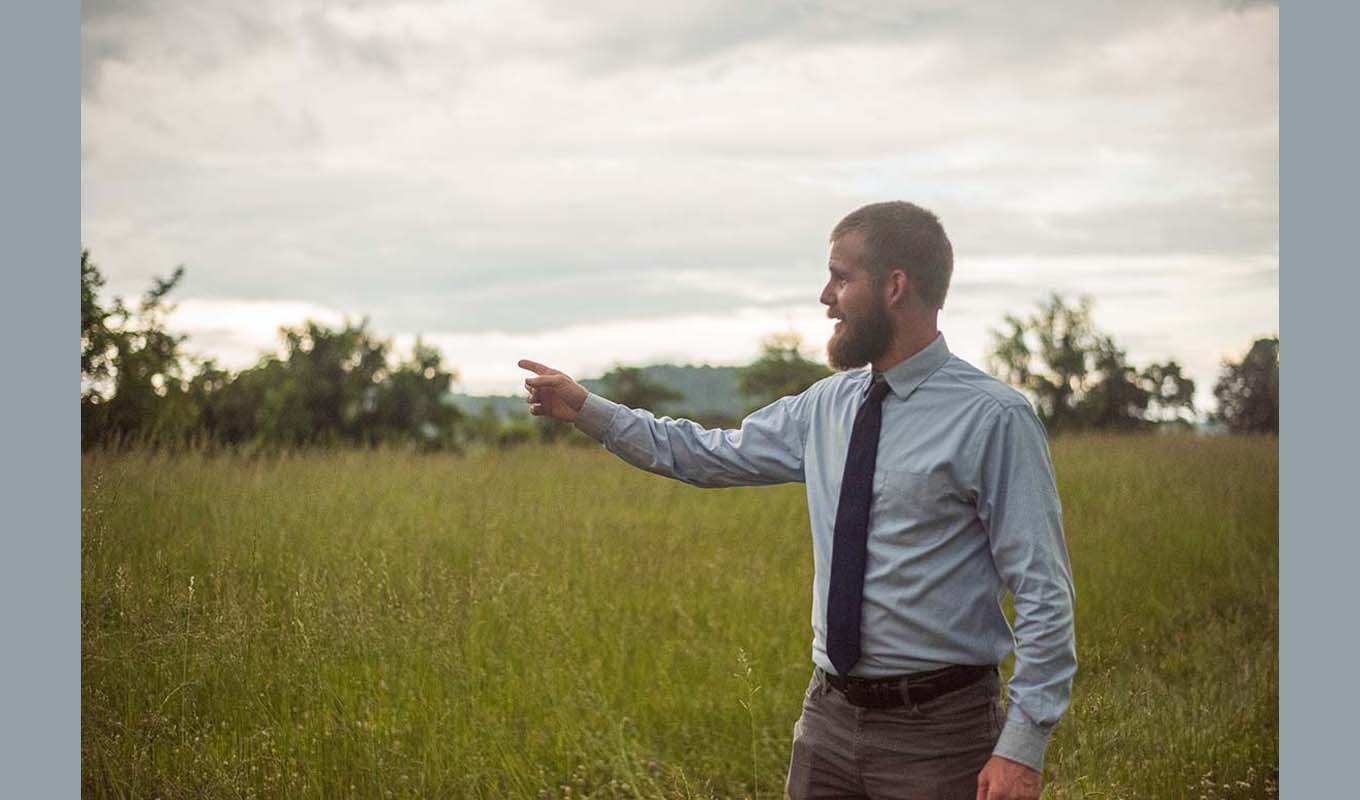
Thomas Fickley, St. Dunstan's Academy founder and headmaster, gestures on the Anglican school's property. (Photo courtesy The North American Anglican, NorthAmAnglican.com)
Thomas said the group membership is working out well.
“It’s been great,” he said. “It’s very simple to use. It’s very predictable and all our families’ needs have been taken care of.”
The school cuts a single check to a member each month, representing its staff members, but when a staff member’s family has a need, they submit it themselves and receive Shares from other members.
Mark said having his family’s medical needs taken care of through the ministry and having their money go to other believers is a blessing,
“When we get checks from other families (for medical needs), it’s a million times better than being with an insurance company,” he said.
Health care sharing provides community
Thomas said that providing for his staff’s health care in a Christian context is important for St. Dunstan’s approach to Christian community.
“We are trying to take care of our community’s needs as close to the source as we can,” Thomas said. “One of the main issues in contemporary society is that it has become far too corporate, and our basic needs have been distanced from the people who are providing those needs.
“So what we liked about Samaritan is that instead of paying into this giant pot for people that we have no idea who they are, there are real people on the other side of this who have actual, concrete needs for their health care. And when we make a contribution, when we pay our Shares, we are contributing directly to their family’s needs. This feels much more communal. It feels much more personable. It feels like we’re contributing something to other members in the Body of Christ.
“Those are values we have for the school in general. We’re trying to keep things small in a meaningful way. We’re building our own buildings. We sing together, we make music together, we worship together at the school. We’re trying to integrate our whole life together in light of our ontological unity in the Body of Christ, and Samaritan is a much better fit for that vision of flourishing in the good life than the kind of big, nebulous corporate insurance world is.”