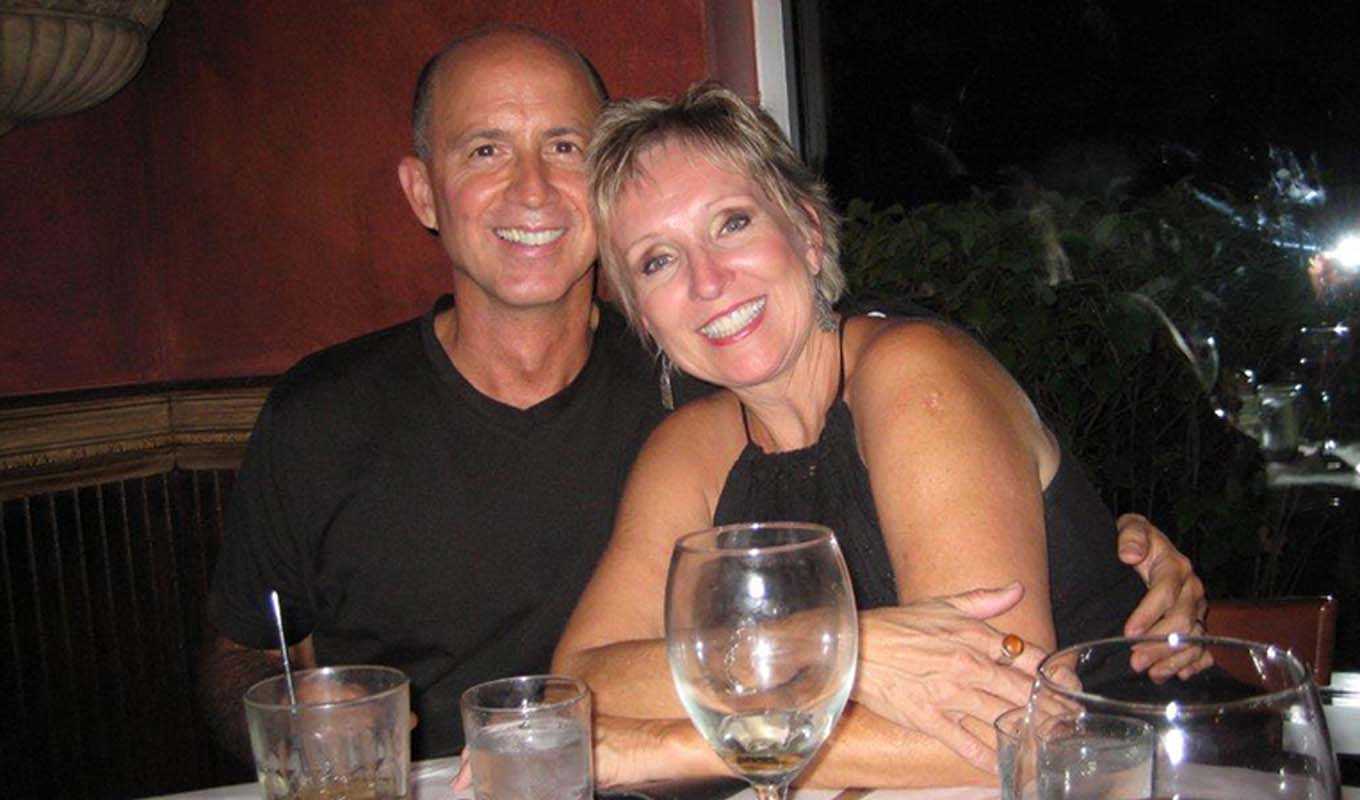
Samaritan member with Parkinson’s disease completes marathon, triathlon
By Mike Miller · Dec 08, 2013
Gary Smith isn’t taking his Parkinson’s disease lying down.
He’s taking it on the run, on bikes and in the water, having completed a marathon in 2011 and a triathlon in August. In the marathon, he ran 26.2 miles. In the triathlon, he swam one fourth of a mile, rode a bike for 13 miles and then ran 5 kilometers (about 3.1 miles).
“I’m probably in the best shape of my life,” Gary says. “It’s amazing what training for a marathon and triathlon can do. It’s like, ‘I’m not too bad for 58 years old.’”
The Samaritan Ministries member first noticed symptoms of the disease when encountering soreness and weakness playing basketball at his 50th birthday party eight years ago. His crossover move wasn’t working, resulting in soreness and weakness on his right side.
“I thought, ‘What’s that all about?’” says Gary, who lives in suburban Chicago with his wife of 33 years, Nan. “I just thought it was age.”
He didn’t think anything more about it until a couple years later, when Nan noticed it looked like something was wrong in the way he picked up their luggage at an airport. She told him he should get it checked out, but, “being a typical guy, I put that off.”
When he did finally go to a movement disorder specialist in 2008, he got the news: He had Parkinson’s, a progressive, degenerative disorder of the central nervous system that causes tremors and stiffness.
His first reaction was to tell God that He should repent for letting Gary have the disease. He says he told the Lord that he wasn’t the one who “was wrong here, You’re the one Who’s wrong.”
“I kept saying, like Job did in Job 19, ‘You need to hear me out, because I’m right and You’re wrong,’” Gary says. “It really shook up my faith there for a while.”
That went on for two weeks, until he realized God was telling him, “You want more from Me than of Me. You’re not just satisfied with Me.”
Adding to Gary’s angst were the memories of his earthly father, who had suffered with the disease for 22 years. Gary didn’t want to go through the same thing.
“All I can remember is the last few years of Dad’s life being pretty rugged,” says Gary, who had “a snapshot of myself being bedridden, with everybody having to do something for me.”
But Gary came around and did the repenting, like Job did in chapter 38.
Then he got to work.
Gary found out through his online research that the cliche “use it or lose it” is especially true with Parkinson’s. He decided he needed to stay physically active. Basketball, which he had played two or three times a week, was out due to a neck injury, so he started to lift weights and stretch daily. When the disease has started to drag him down, medications have helped to pick him back up by helping his strength, stiffness, and fatigue.
Dr. Murray Grossan of Grossan Institute says that regular exercise for Parkinson’s patients has not only physical benefits but emotional ones as well.
“Exercise offers a goal to work at daily,” he says. “This goal, path, can be of major emotional benefit. The physical act of exercise helps to build muscle strength and improve the brain-nerve-muscle circuit. The more the exercise, the more healthy nerve circuits are created in the brain. The chemistry of making those new circuits is overall beneficial. In the science of neuroplasticity we know that new areas of the brain can be awakened and taught new functions.”
Gary taught his brain enough new functions to run a marathon on the University of Illinois campus in Champaign-Urbana, Illinois, in 2011 in five hours, 55 minutes. He achieved that time despite having to stop frequently over the final nine miles to stretch his cramping legs.
Completing a marathon is a great accomplishment for anyone, let alone someone with a debilitating disease. Gary’s neurologist told him that running a marathon with Parkinson’s was like adding a third to the race.
Adding to his marathon, Gary finished the 2013 Naperville (Illinois) Sprint Triathlon on August 4 in in one hour and 43 minutes—again, quite a feat for anybody, let alone someone fighting Parkinson’s. He finished54th in the Men’s 55-59 division.
Now between competitions, he starts working out between 6:30 and 7 a.m. every day. The stretching is difficult for him—“It feels like you’ve just spent a couple hours in the trunk of a car every morning when you get up”—but it’s one of the best things a Parkinson’s patient can do, Gary says. When he was preparing for the triathlon, he would run in the morning after the stretches and weights, or ride a bike, or go swimming.
The most enjoyable activity he engages in is dancing to whatever music’s available, “anything I can feel a beat to,” especially with Nan. Dancing gets both sides of his body moving, which is important for a Parkinson’s patient; if one side gets weak, the other side compensates, which then is a further stress. He also has brought his Ping Pong game back up to its previous level and plays golf once a week.
“Anything done while moving” is beneficial, he says.
Keeping Gary in shape has also provided an opportunity for he and Nan, who together offer marriage counseling through their Still the One service, to do more things together. They’re riding bikes together again for the first time in more than a dozen years as part of Gary’s triathlon training and are joining a local YMCA for swimming through the winter.
Feeling well, though, isn’t the only reason Gary’s working so hard.
“We just became grandparents for the first time” in March, he says. “I saw little Amos and told him, ‘I’m going to be running and biking for you, buddy. I don’t want to miss out on all your years coming up.’”
He is grateful to Samaritan Ministries members for helping him to meet his medical needs connected to the Parkinson’s.
“It’s been a Godsend,” he says.