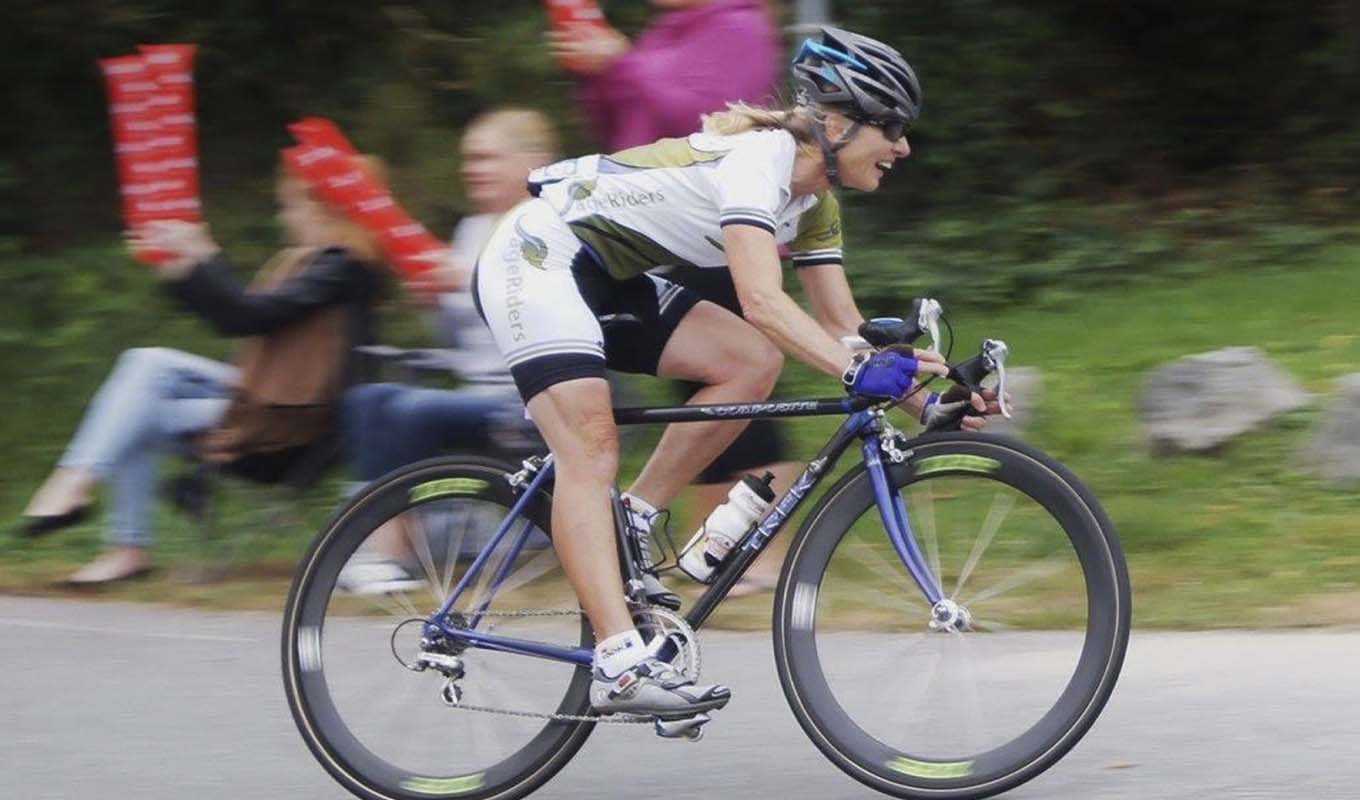
Samaritan member back on the road after treatments to hip, knees
By Michael Miller · May 20, 2022
Samaritan Ministries member Marilyn Trout has ridden bicycles thousands of miles over the past 30 years—including two Tour de France competitions—but knee and hip problems started slowing her down about 16 years ago.
Thanks to a stem-cell procedure for orthopedic problems highlighted in a 2017 Samaritan newsletter, she’s back on the saddle, just returned from a hiking trip in Spain, and is headed to a Tour reunion in France.
Marilyn will also be featured in Uphill Climb, a new documentary about the first women’s Tour de France races (1984-89).
The right-knee pain came after a chiropractor’s apparent mismanipulation of Marilyn’s back several years earlier that resulted in a bulging disc affecting the L4/L5 spinal segment. Eventually, this manifested itself in the right knee. Since Marilyn is now a professional landscaper in Colorado, bending is part of the job and the injury was a constant challenge. Just getting up from a kneeling position was an adventure and her leg muscles began to atrophy.
“Everything was arms, arms, arms,” she said.
She received some hyaluronic acid injections in her right knee, and the temporary relief inspired her to enter the cycling road race in the 2016 America’s Masters Games. She won the silver medal, but the next year “the left knee went.”
“If I got down on the floor, I could not get up,” she said.
Then in fall 2017, Marilyn read in the Samaritan newsletter about Centeno-Schultz Clinic, a Regenexx provider near her in Colorado that uses a person’s own stem cells to promote orthopedic healing. Regenexx focuses on “the use of orthopedic bone marrow concentrate to treat common orthopedic conditions to help people avoid surgery (by) using cells from their own body,” according to Regenexx.com.
After it had become clear that her other treatments weren’t working, she contacted the Centeno-Schultz Clinic in the Denver area and had both knees treated as well as the spinal segment.
“As soon as they did the first treatment and stabilized my joints, putting those braces on and pulling those kneecaps into place, I said, ‘This thing is going to work,’” Marilyn recalled. “Within a week, I was doing core exercises and stairs. Two weeks later, I started rehab. Five weeks later, I was back on the bike with braces, and seven weeks later, my husband, Michael, and I went to England to hike for two weeks on uneven ground.
“They were like new knees. It was amazing.”
Then, four months later, she fell while trimming weeds and much later found out she had torn the labrum in her left hip. For 2½ years she had physical therapy, massages, and dry needling, but it was still “constant pain and debilitation.”
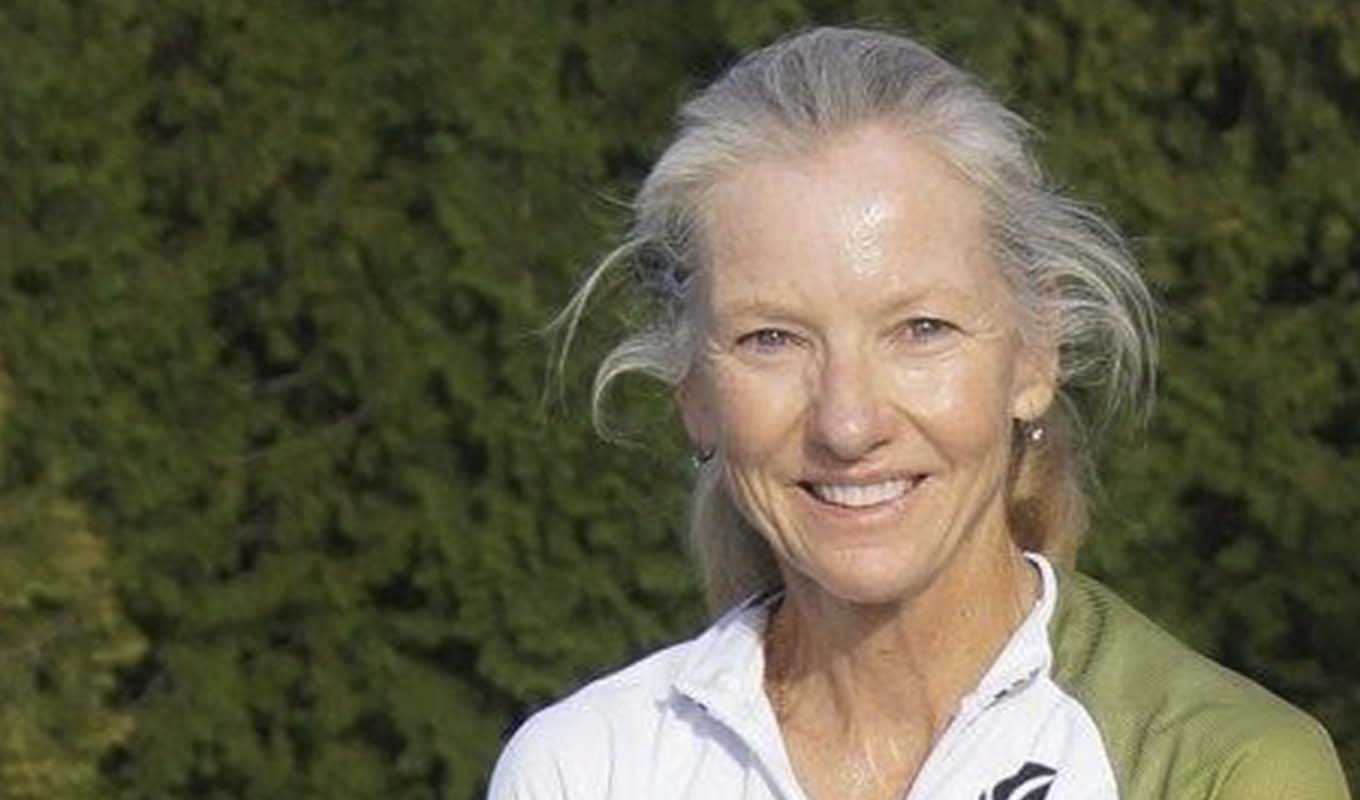
Marilyn Trout
She finally called Centeno-Schultz again. Typically, the remedy for her particular ailments—a severe labral tear and osteoarthritis in the left hip and sacroiliac joint—would be surgery and a hip replacement. However, Centeno-Schultz said they could perform a stem-cell and platelet-rich-plasma (PRP) procedure on the problem areas. She had the treatment in January, “and within a week I was walking three miles,” taking the hiking trip to Spain by March.
Marilyn says that, while stem-cell treatment or PRP may not be for everybody, in her case it was less expensive and less painful than surgery, and had a much quicker recovery. Follow-up physical therapy, however, is necessary in either case.
Those who do opt for stem-cell treatment, she said, should closely follow directions from the provider on how to prepare for the stem-cell extractions, especially by being well-hydrated.
She also urged others to “do your evaluation (with the provider) first and then see where it goes.” Michael, her husband, had a major tear in his bicep tendon and, after a preliminary evaluation at the Centeno-Schultz Clinic, he was advised to have surgery, then possibly stem-cell treatment.
Cycling career
Before Marilyn started needing treatment on various joints, she was a world-class cyclist.
Her interest in cycling was first piqued during high school when she saw a photo of British cyclists in the newspaper in her small hometown in Ontario, Canada.
She joined the local club and “jumped in the deep end with 50-mile rides,” Marilyn said. “Little did I know there were several world champions in that little cycling club.”
The first couple years were tough and discouraging for her. She didn’t like “the rigors of competition.”
“I couldn’t seem to get ahead,” she said. “It was just so incremental. I hadn’t been in sports in high school, but there was something that grabbed me and had to keep on with the pursuit.”
She believed she ultimately would succeed in cycling, though, “because the Lord had given me this idea, and He doesn’t set us up for failure.” She decided that there was something He wanted to reveal to her if she did her best.
There was only one other woman in that first club, so she and Marilyn trained with the men. That led to trips to the U.S. “to get some harder racing.” She went to the world championships in 1980 with the Canadian team and remained in the program through 1981.
After high school, she went to Ontario Bible College for a year and met a coach at a training facility in Toronto for people with disabilities. Besides finding someone to help her train, she also became interested in helping the disabled. Eventually, she took some time off from cycling in 1982 and went to the University of Toronto to study physiology.
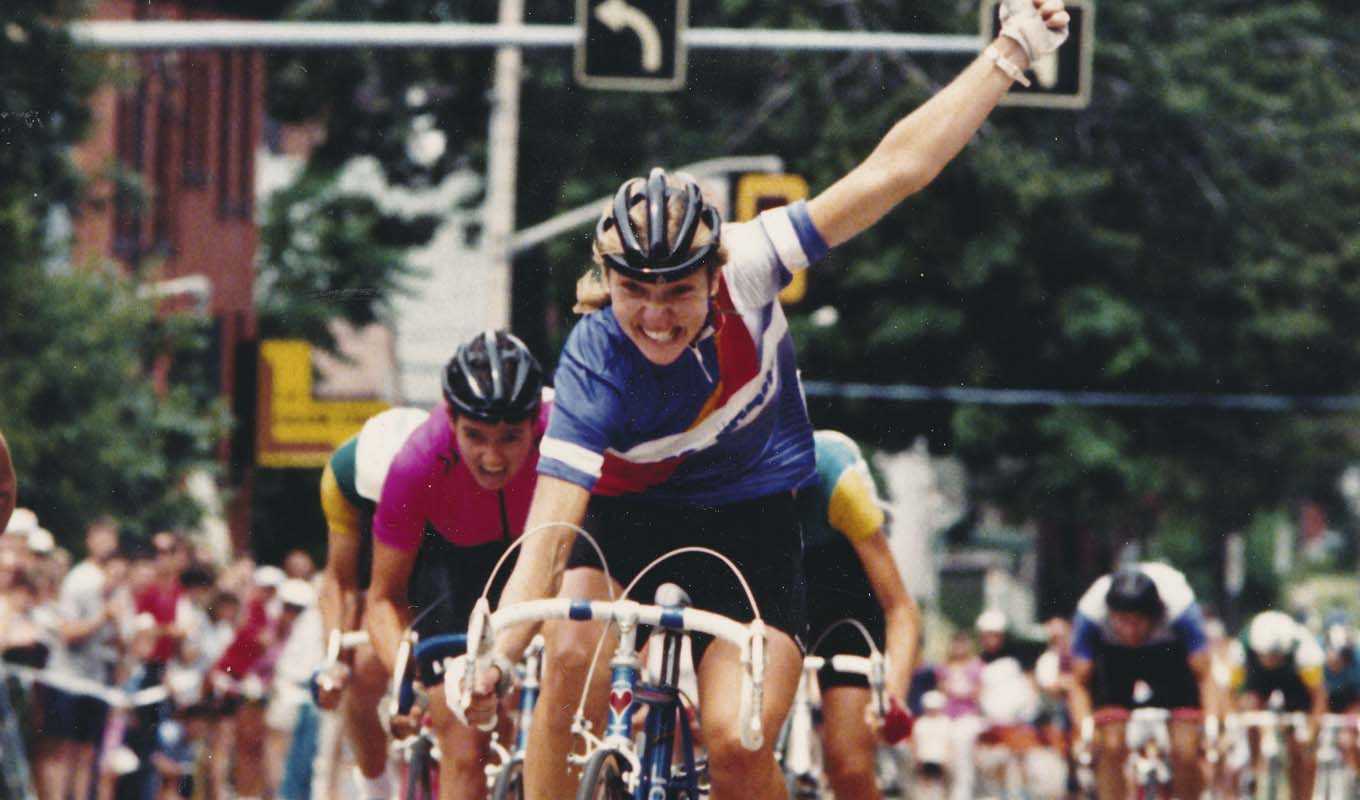
Marilyn Trout wins the 1985 Canadian National Criterium Championships.
Then she tried out for the Canadian road race cycling Olympic team in July 1984. Although she didn’t make the three-member team, her effort opened the door for her to join the Canadian team for the first women’s Tour de France, becoming the team captain. The grueling 1,100-kilometer women’s version had 18 stages over three weeks, going from flat terrain to mountain-top finishes.
The organization of the race was as much of a challenge for the women as the roads and hills, Marilyn said.
“It’s like a traveling circus with its entourage of team cars, luggage vehicles, ambulances, police motorcycles, media vehicles, and cyclists,” Marilyn said. “It’s phenomenal.”
The pressure was almost as challenging as the distance, she says.
“You’re full-on all the time. That’s why it was so important to get refueled, recovered, get the legs massaged, get the bike worked on. Those mechanics work through the night. It’s like doing a marathon full out every day.”
The course includes the Alps and Pyrenees mountains, presenting 20-kilometer climbs. Marilyn’s specialty was sprinting, so her ambition was to gain points for the “Green Jersey,” signifying the points leader, through that particular “race within a race.”
Marilyn was again on the Tour de France Cycling Canada team in 1987. Her highest stage finish was third place, in 1984, and her highest overall was eighth, in 1987.
Sharing Christ
Her cycling career was not just about how high she placed, though. It was about Who she could share, as well.
“Early in my career, I wrote in my training journal, ‘You can do all things through Christ Who gives you strength, and He has not set you up for failure,’” she said, paraphrasing Philippians 4:13. “I took that at its word and applied it to myself.”
Another Scripture passage that kept her focused and motivated in times of doubt or exhaustion was 1 Corinthians 9:24-25: "Do you not know that all the runners run, but only one gets the prize? Run in such a way as to get the prize." "Everyone who competes in the games goes into strict training," she says. "They do it to get a crown that will not last, but we do it to get a crown that will last forever.”
Marilyn knew she had a responsibility to do her best and, if she was first, many times that would open a door to share Christ.
She said she was surprised that when she went to compete in the 1986 world championships in Colorado Springs, Colorado, there was no evangelistic outreach since many prominent Christian ministries are based there.
“The world was coming to meet them in their own backyard,” Marilyn said.
A pastor friend suggested that she start something, so she did: the International Christian Cycling Club. She also typically shared her testimony when traveling, especially if she was in a location for a month of traveling.
“I would find a church and get involved to be spiritually fed, and I always found great people,” she said. “I was a Christian disguised as an athlete instead of an athlete disguised as a Christian. It was everything to me as far as being a Christian, and that’s the same thing right now with my landscaping business. I can get into people’s gardens, and that leads to unique opportunities for service, friendship, and spiritual conversation.”
She also has used the bike to disciple others.
“I was more comfortable asking someone to come for a ride with me and talk rather than sitting at a coffee shop,” Marilyn said.
Michael Miller is editor of the Samaritan Ministries newsletter.