
Ray King 'saw Jesus at work in every area of life'
By Michael Miller · Aug 19, 2025
Ray King was a guiding force for Samaritan Ministries from its first days.
Known for his emphasis on a biblical worldview and compassion for those in need, the former Samaritan vice president of communications and original newsletter editor passed away July 21, surrounded at his Groveland, Illinois, home by loved ones, including his wife of 50 years, Marsha. Ray is also survived by seven children and 32 grandchildren.
He was 75.
“The heart and soul of Samaritan Ministries would not exist today without Ray King,” said Anthony Hopp, Samaritan Vice President and Chief Purpose Officer. “Ray believed that the redemptive power of Jesus is at work in every area of life, including health care, and had the courage to stand by and support founder Ted Pittenger in the early days of Samaritan when scores of people told Ted and Ray that health care sharing would never work.
“His commitment to a Biblical worldview combined with a passion for thoughtful reflection, seeking the truth, and asking the right questions in the first place has positively influenced me, countless others, and Samaritan Ministries in too many ways to count.”
First connections
Health care wasn’t in Ray’s sights as he started his career. He graduated from the University of Illinois with degrees in agriculture and agricultural communication, first working for The Navigators and then as a hog farmer. He met Samaritan founder Ted Pittenger through homeschool organizations and then worked for Ted’s painting and wallpapering business.
In one conversation during a job, while Ted was still fighting to get Samaritan off the ground, Ray challenged Ted’s thoughts on the ministry’s money-making potential.
“Would you still want Samaritan to succeed if you knew you weren’t going to make much money at it?” Ray asked.
Ted decided that “As long as God paid the expenses, I would do this for free.”
Later, Ted saw that moment as a turning point in the ministry’s development.
Ray eventually ended up as a founding member of the Samaritan Board of Directors. Soon he was Samaritan employee No. 3, helping out with a little bit of everything, as everybody did back then. He soon emerged as its chief communicator, creating the Samaritan Ministries Christian Health Care Newsletter and guiding the ministry’s advertising efforts.
“Ray’s fingerprints are all over this ministry,” said Ted, former ministry president and still a Board member. “In communications, he would insist that words mean something, so he was specific about how we talked about Samaritan and about health care sharing.”
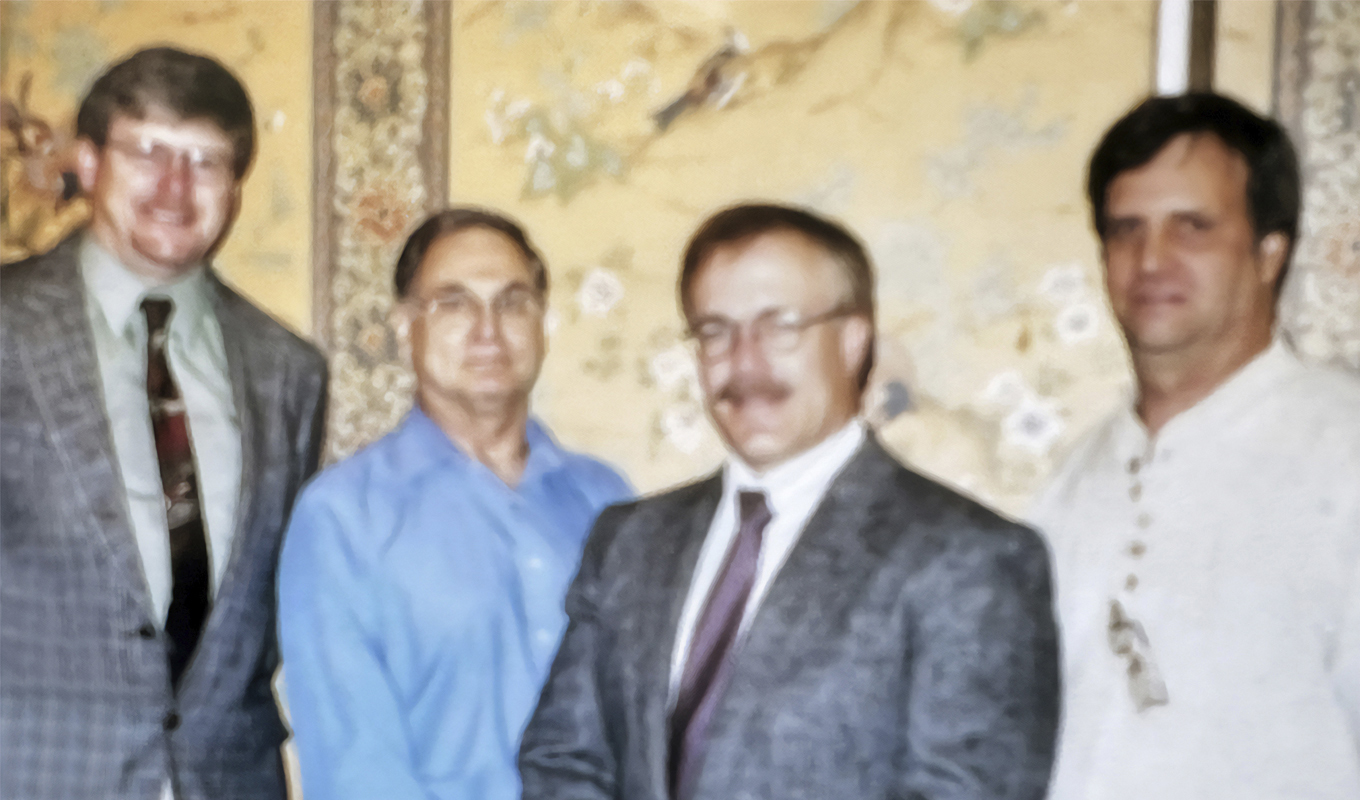
Ray King, far right, poses in this undated photo from the early years of Samaritan Ministries with, from left, Board of Directors members Jamie Pyles, and Bill Kurth and Samaritan founder and then-President Ted Pittenger. (Courtesy Shari Pittenger)
For instance, Ray is the reason that “health care” is two words in Samaritan materials rather than one word, “healthcare,” like it is nearly everywhere else, Ted pointed out.
“He thought that ‘healthcare’ as one word treated it as a commodity,” Ted said. “Health care as two words is caring for your health. It’s a subtle difference, but Ray thought it was important.”
Ray is probably most familiar to Samaritan members for his Doorpost feature on the last page of the ministry’s monthly newsletter. The Doorpost has offered brief meditations and insights into Scripture passages to close off each month’s communications for nearly 30 years, letting Scripture have the last word of each issue.
Always contributing
Even after he retired, Ray would still make himself available for insight and encouragement as a consultant, regularly meeting with Ted and then, later, with CEO Mark Zander. He also would touch base with Board members when a meeting was held at Samaritan’s Peoria facility.
“The foundation that he and Ted set way back when will endure into the future as far as Samaritan goes,” said Board Chairman Jim Taggart.
Mark Zander said he met weekly with Ray for at least three years, but their first meeting was perhaps the most vivid.
“I really felt the Holy Spirit saying, ‘You and Ray need to spend a lot of time together,’” Mark said. “Ray was a visionary in how Samaritan should operate from a biblical worldview. I wanted to spend a lot of time with him because he was the heart and soul of how to do that.”
Mark said that Ray helped him understand “how Samaritan walked things out in a countercultural, biblical way.”
“Related to that was how we want to do all our daily activities in a way that was completely contrary to how a health insurance company would operate,” he said. “He taught me so much about how he believed the ministry should operate. I use all of that to this day. As we have to change and innovate and fix things, I always try to keep Ray’s thoughts in mind.”
Worldview connections
The emphasis on a biblical worldview was an early connection between Ray and Mark Blocher, a former Samaritan Board member and the co-founder of Christian Healthcare Centers in Grand Rapids, Michigan. The two met in the late 1990s through Worldview Institute, and Ray quickly put Mark to work writing for the newsletter.
“Our desire was for the membership to understand how the Christian worldview provides a lens to view everything that goes on in your life,” Mark said. “We spent a fair amount of time working it out in those articles: What does that worldview look like in health care?”
Mark brought that understanding to his efforts setting up Christian Healthcare Centers, the founding of which Samaritan leadership helped guide.
“One of the big things I learned from Ray was just the whole philosophy of Christian medical expense sharing,” Mark said. “Like many people, it took me a while to kind of wrap my mind around what that was, and then I realized that it was a superior way for believers to take care of medical needs.”
Ray’s friendship
Samaritan staff members will also miss his friendship and care.
Communications Specialist Brian Estell said that Ray, whom he had known for several years before being hired at the ministry, continued being his friend “while also being my boss.”
“Although he always seemed to have a dad joke to tell, which he told in a way that seemed believable until he cracked a quick smile, Ray was an extremely thoughtful man,” Brian said. “My wife and I have gone through some hard struggles, and I remember his focused attention on our challenges and the advice he gave, and sometimes tears.

Ray and Marsha King post with their seven children and 32 grandchildren in the early 2020s. (Courtesy Ray King family)
“Samaritan Ministries has not only lost a pioneer in health care sharing, but I have lost a dear friend.”
Impact going forward
Ray was also instrumental in shaping Samaritan’s Mission and Purpose statements, Mark Zander said, pointing out that the Purpose statement focuses on the two greatest commandments: loving God and loving your neighbor.
“To me, that’s going to transcend over time, and it sets the foundation for this ministry, which is all about kingdom impact,” Mark said. “It’s not a business, and Ray didn’t want it to be a business, and I don’t want it to be a business, so Ray’s influence on the Purpose sets the tone for us going into the future.”
Jim Taggart said that as the Board and Samaritan leaders began working on Samaritan’s program offerings through REDEEM™ HealthShare Ministry, they “pored over Samaritan’s Purpose, pored over our Mission, and pored over our values, and one of those Values is being Jesus-centric in all that we do.”
“That is what carried us the first 30 years, and that’s the first thing we did when REDEEM HealthShare was designed, is carry over the things that make Samaritan Samaritan,” Jim said. “I think those things that Ted and Ray designed and implemented in the formative years of Samaritan will be present in the formative years of REDEEM.
“The other things that will carry over as a legacy of the Lord and a legacy of Ray are all of the Doorposts that he wrote.
“All those things are foundational to who we are.”