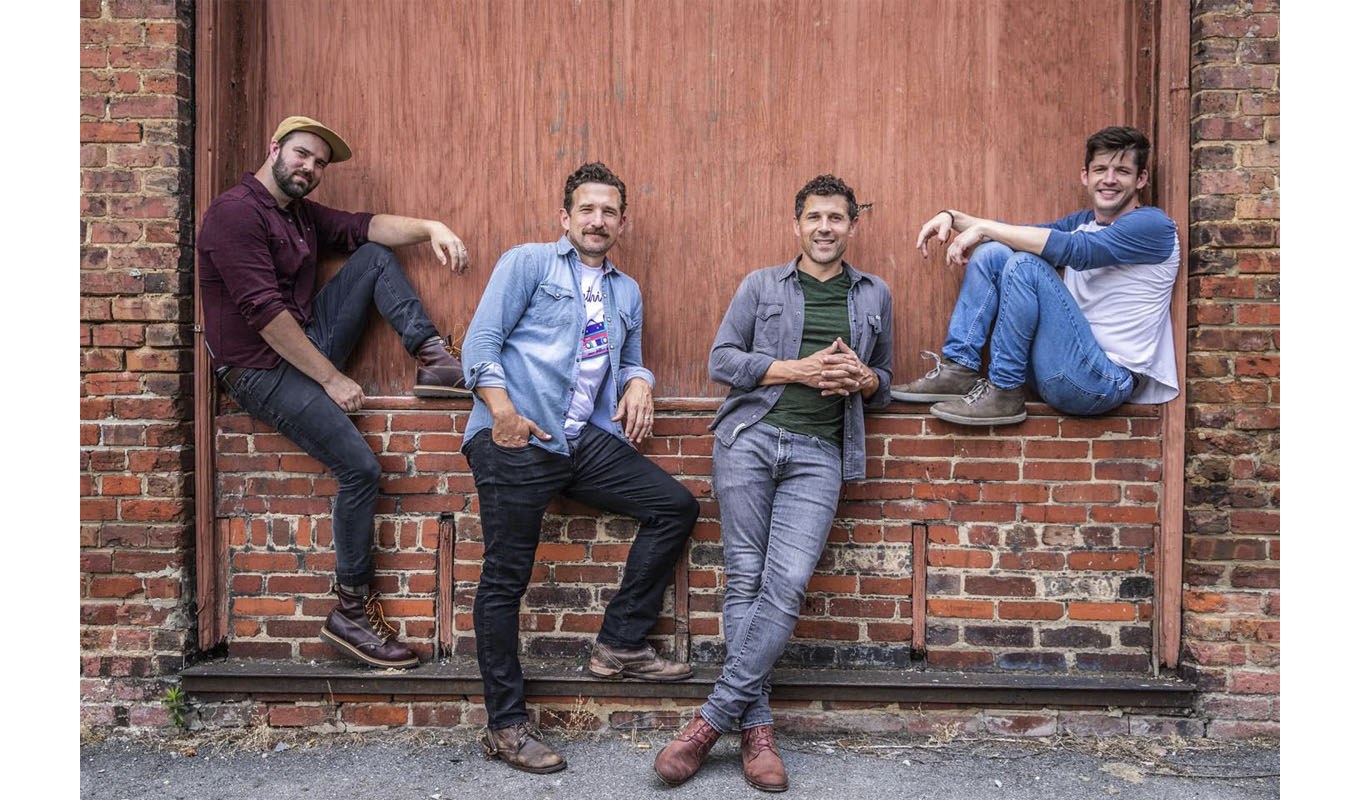
Member Spotlight: Danylo and Alexander Fedoryka of Scythian
By Michael Miller · Mar 20, 2024
Why SMI? Fedorykas like "prayer requests and accountability."
Alexander and Danylo Fedoryka have memories of always making music.
Now, the brothers make memories for others with their music.
The two founders of the Americana/Irish band Scythian have been performing their high-energy songs in intimate Irish pubs and on large festival stages for 20 years. They also host their own annual festival and lead tours to Ireland. In the meantime, they have produced 16 studio albums.
“When we started, we had the motto ‘Music Among Friends,’” Danylo said. “That was our mission. We always said, ‘Check your inhibitions at the door and let go and be joyful for one or two hours and forget about your worries.’ Then, they can go back to their regular lives feeling refreshed.
“Twenty years in, I can say that we see the magic is still happening.”
Talents glorify God
Alexander and Danylo are two of 10 children born to Ukrainian immigrants who escaped to the U.S. with their parents in 1948 just as the Soviet Union was closing the Iron Curtain on Ukraine.
“My mom, Irene, graduated from the Julliard School of Music as a concert pianist and started her career performing in New York City,” Danylo said, “but she kept on hearing in her mind, ‘What profiteth a man to gain the whole world and lose his soul?’ (cf. Mark 8:36). She felt God was asking her to step away from that life, so she set aside her career as a concert pianist and then met my father, Damian, and they got married and had 10 kids.”

Danylo and Alexander Fedoryka dress in traditional Ukrainian garb.
But that was far from the end of her life in music. As each child was born, she would assign them an instrument to start playing later “by looking at our hands,” Alexander said.
Lessons on those instruments would then start at 3 years old. For Alexander, it was the violin, which he still specializes in. Danylo started on piano but moved to guitar and accordion as his musical exploration expanded.
“We performed classical music as a family ensemble,” Danylo said. The Fedorykas would play at nursing homes and benefits for children with cancer, establishing the giving spirit in their own family.
“My mom really emphasized the fact that our talents are gifts from God and a way to glorify Him,” Alexander said. “That’s a theme for us. We’d always start our shows and rehearsals with a prayer. The emphasis was that we were playing classical music, but if you play well, the Holy Spirit can work through the good, the true, and the beautiful, and He can touch people’s hearts. Our talents are meant to be shared, to glorify God, and to spread the Kingdom. Music was constantly alive in our home.”
Music and God, Danylo said, “were woven into every fiber of our being.”
So was the Ukrainian culture.
“Our parents felt a duty to transfer the culture, the language, the songs, the dance to our generation because it was a form of preservation in the Ukrainian diaspora,” Alexander said.
Expanding horizons
Living in Virginia, though, Alexander and Danylo couldn’t help expanding their musical horizons as they grew older. While they had been diverted from rock and pop music growing up, the region’s bluegrass couldn’t help but find its way to them. As the musical gatekeeper of the family, their mother found the genre interesting.
“It had a nice theme to it, very often Bible themes, as well as beautiful singing and beautiful harmonies,” Alexander said. As string-based music, it was naturally attractive to the brothers with their talents on guitar and fiddle, but “in a more casual way,” he added.
That exposure led naturally to interest in Irish folk music.
“Dan introduced me to Irish fiddlers, which was this incredible world of music in the sense that there was great skill that I had not been introduced to in classical violin,” Alexander said. “I became enamored by the driving music, the energy, the way people could dance to it or stomp their feet to it.”
Alexander didn’t just learn the fiddle tunes—he went to Ireland for four months to immerse himself in the music. He brought tunes back and teamed up with Dan, who as a teen had switched to guitar as his main instrument. The two started playing bluegrass and Irish tunes at friends' homes, "and the next thing you know, people are clapping and dancing,” Alexander said.
That period was the first stirrings of what would become Scythian. Their performances would involve the Irish music they had been learning, plus the bluegrass they knew, along with the Ukrainian music they had grown up with.
“Our music always had the sense that it was coming at you from many influences and different cultures,” Alexander said. “It sort of ended up being an expression of our story.”
“The genre was ‘old time, good time,’” Danylo added. “Our music is a little bit of a melting pot.”
Birth of Scythian
Alexander and Danylo quit their jobs the same day in 2004 "to force ourselves to go full time with the band," Alexander said.
Scythian was born.
The name came from ancient horsemen of the steppes of what is now Ukraine.

“They were known to travel long distances, and there was a lot of mixing of cultures,” Danylo said. “We felt like it represented us a little bit. The Scythians mixed with the early Celts, who would shape Irish culture, and the Vikings. There was a lot of mingling of cultures there. It kind of answers the question, ‘Why are Ukrainians playing Irish music?’ I had to go back to 1000 B.C. before I could find a connection with that.”
The band initially had three members—the Fedorykas and a college friend. Their sister, Larissa, played cello with them for five years while getting her music doctorate. Another sister, Melanie, played fiddle and whistle on their first recording, Dance at the Crossroads, and Alex’s wife, Catie, is featured on vocals in several recordings.
The current unit, which includes Ethan Dean on bass and vocals and Johnny Rees on drums, bonded during COVID-19 lockdowns in 2020. With a St. Patrick’s Day gig suddenly canceled, the band live-streamed from a kitchen that day for the first of several “quaranstream” concerts.
Sixty thousand viewers logged on for that concert as Scythian played for about three hours.

Members of Scythian perform onstage (supplied photo)
“Then we realized, ‘Guys, maybe this is what we need to do,'” Alexander said. “People were thanking us because they were basically marooned in their houses. They had no community, but community started forming around our streams. Every two weeks we got together, and we would play for about three or four hours. Every stream had a theme.”
It also turned out to be a way to keep income flowing for the band members’ families through donations, since musical groups weren't considered essential services under federal relief bills.
Over 600,000 viewers watched Scythian’s 30 livestreams during the lockdowns.
Helping refugees
Scythian has also been using its popularity to help refugees from the current Ukrainian war with Russia. All income from sales of their music at their store will help refugees and is being matched by a $100,000 grant offered to them out of the blue.
“I was praying at church and said, ‘God, I think I’m called to help incoming refugees because my parents were refugees, but I don’t know how to do this, so just show me the way,’” Danylo said. “Six hours later, I got a phone call from a woman who said, ‘You don’t know me, but I just got a $100,000 matching grant to help Ukrainian refugees and I want your band to be the spokesperson for this grant.’”
The fundraiser is nearing its end but has raised about $7,500. Many have donated money without even downloading an album, the Fedorykas said.
The band also just launched a new video of their song “Motherland,” which features traditional Ukrainian costumes and dancing.
“These refugees need a place to be able to start their life,” Alexander said. “That’s part of our story. Our family received it. We’re so grateful to be Americans now because of all the blessings that many of our cousins didn’t get.”