
Breaking down more food labels: What do the call-outs mean (part 2)
By Anna Moore · Oct 17, 2025
Part 2 of 2.
Marketing labels on food products can be confusing or even misleading. We continue explaining what some of the labels in today’s grocery stores mean with more common labels you’ll see on the shelves.
‘Certified Gluten Free’
Gluten has become somewhat of a buzzword over the past couple of decades, and food companies have capitalized on that. By labeling products as “gluten free,” they may be trying to convince you it’s a healthy or healthier choice—even when it’s gluten-free to begin with. For instance, fruits and vegetables, quinoa, rice, and oats are all naturally gluten-free. The concern for those adhering to a gluten-free diet arises when the food is cooked or prepared with other ingredients, or when there’s a risk of cross-contamination where they are processed.
The “Certified Gluten Free” label lets consumers know the product is safe and trustworthy if they are avoiding gluten. According to the Gluten-Free Certification Organization (GFCO) website, “GFCO ensures that gluten-free products are safe and trustworthy. GFCO works with manufacturers to help them achieve certification and improve their processes to meet our strict 80-point Standard, including requirements that all starting ingredients and finished products test below the applicable gluten-free threshold of the country of sale, or 10 ppm [parts per million] (whichever is lower).”
The certification indicates the product has a very low amount of gluten, low enough to be considered safe for people on gluten-free diets. The organization helps manufacturers interested in certification improve their production processes to avoid gluten contamination.
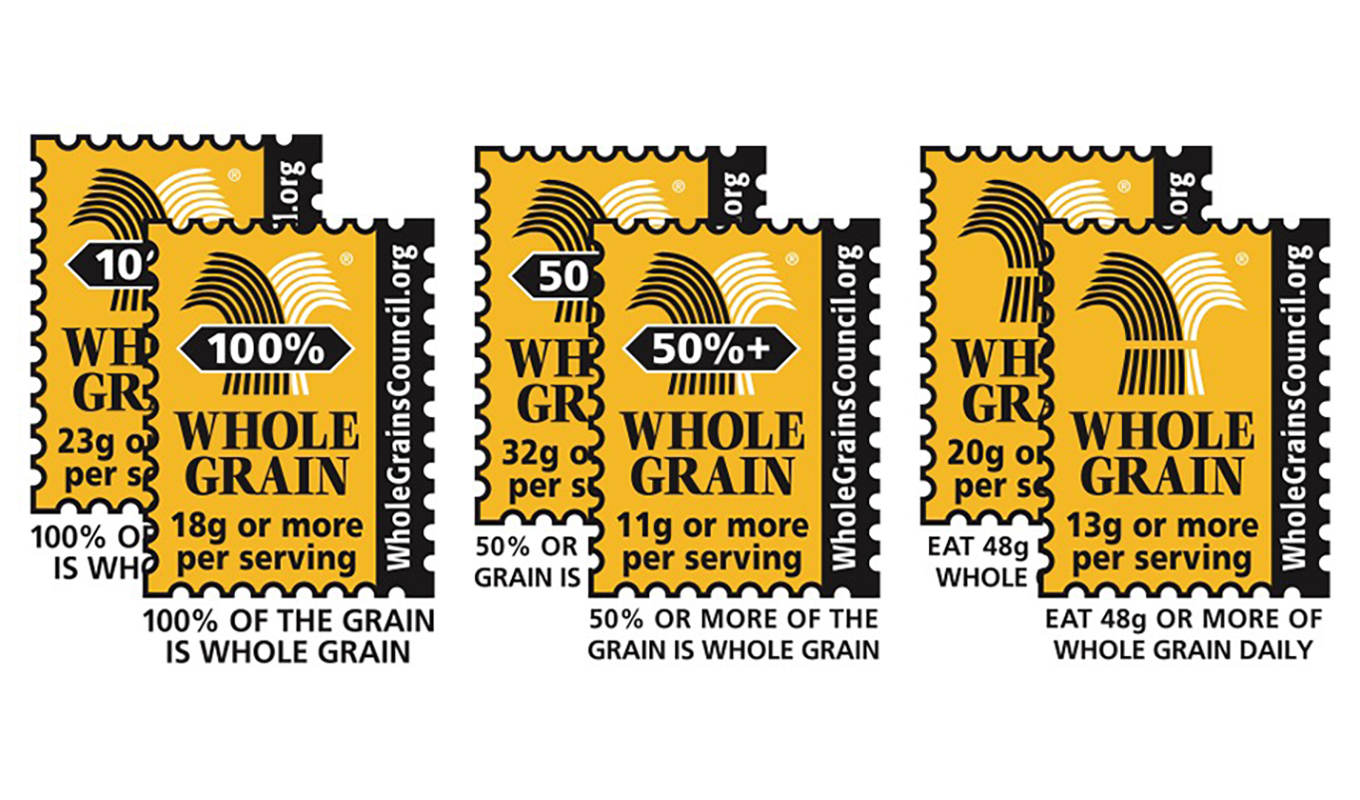
‘100% Whole Grain’
The Oldways Whole Grains Council developed the golden-yellow whole grain stamp to tell shoppers which products contain true whole grains. The stamp comes in three varieties: 100%, 50%+, and basic to show how much of the product’s grains are whole.
The 100% stamp means all of a product’s grain ingredients are whole grain. Products with the 100% stamp are required to have a minimum of 16 grams, which is considered to be a full serving, of whole grain per labeled serving.
The 50%+ stamp means at least half of the grain ingredients in the product are whole grain. Products with this stamp have a minimum requirement of 8 grams of whole grain per labeled serving.
The basic stamp means the product contains at least 8 grams of whole grain, though it might contain more refined grains than whole.
Shoppers can search products on the Whole Grains Council’s website to see which whole grain stamp it contains.
While food guidelines for grains have been debated over the years, the USDA has historically emphasized a grain-heavy diet through the food pyramid. It still says 50% of your grains should be whole, while allowing for the other 50% to be refined.
‘Glyphosate residue free’
The Detox Project has three labels seen on some foods. The most common is Glyphosate Residue Free. The certification assures consumers that the product doesn’t contain glyphosate, which is a common herbicide, such as Roundup.
The organization certifies single- and multiple-ingredient food and supplement products.
To receive the certification, the products must have no glyphosate residues “down to government-recognized limits of detection for food, commodity and supplement samples, and lower levels than default government maximum residue limits in the European Union and Japan.”
This certification was created to:
- Reduce consumers’ risk of exposure to glyphosate residues in foods they consume.
- Educate producers about the glyphosate residue profile of their products.
- Enable producers to fine-tune production and supply chain strategies to minimize their reliance on glyphosate-based herbicides.
- Encourage farmers to reduce their reliance on those herbicides.
The Detox Project also manages the CleanScan and Gold Standard Detox labels. The CleanScan label indicates the product is free from specific groups of contaminants such as pesticides, heavy metals, and GMOs. The label contains a QR code that is specific to the product’s brand. It enables consumers to find information on which contaminants the company tests for.
The Gold Standard Detox label means the product detoxes specific environmental toxins from the human body. It certifies that the product detoxes whatever it says it detoxes.
‘Marine Stewardship Council’
The blue “Marine Stewardship Council” fish label appears on seafood products and seafood menu items.
Seafood with this label is wild-caught and “certified sustainable seafood that meets the MSC Fisheries standard.” Wild-caught seafood generally has a higher nutritional value since those animals consume a natural diet. In contrast, farm-raised seafood is treated to a highly processed diet so it will grow more quickly and is also given antibiotics to prevent diseases.
To earn the MSC label, seafood must meet several criteria:
- It must come from healthy and sustainable fish stocks.
- It must be caught using methods that minimize environmental impact.
- It must be sourced from a fishery with effective management practices in place that complies with local and international regulations and can adapt to changing conditions.
‘American Heart Association Certified’
Since the mid-1990s, the American Heart Association has certified certain retail foods as “heart healthy.” Foods with the AHA Certified checkmark label have been approved by the association’s own standards and are considered healthy enough to help prevent heart disease and stroke.
A word of caution to consider is that some foods with these labels, such as cereals, are high on the glycemic index, meaning they will spike your blood sugar. Since diabetes is a major factor for heart disease, these labels can be misleading in that way.
The AHA says all nutrition requirements for the certification comply with federal regulations for coronary heart disease health claims. Nutrition requirements are set for canned and frozen produce, juices, grain-based products, milk and dairy alternatives, smoothies, snacks, yogurt, meat and seafood, main dishes and meals, whole grains, nuts, fish, oils, and fresh fruits and vegetables.
Here are the general nutritional limits set by the AHA:
- Less than 6.5 grams of fat per serving
- 1 gram or less of saturated fat; no more than 15% of calories from saturated fat
- Less than 0.5 grams of trans fat and no partially hydrogenated oils
- 20 milligrams or less of cholesterol
- Equal to or less than 480 milligrams of sodium
- At least 10% of the daily value of vitamin A, C, iron, calcium, protein, or fiber
While many labels found on food items may lead us to believe we are getting a healthy product, that may not always be the case.
When shopping at the grocery store or planning your meals, a wise approach is to do your own research first. Consider your specific dietary preferences and health goals, and follow the best course of action for you and your family.